


There’s one question every outdoor enthusiast asks before heading into the wild: how long does ice last in a rotomolded cooler? Whether you’re planning a weekend camping trip, a multi-day kayaking expedition, or a simple picnic in the park, the answer can make or break your adventure.
Rotomolded coolers—built with the same thick-wall construction used in marine buoys and medical equipment—consistently outperform standard injection-molded coolers when it comes to ice retention. But “consistently” doesn’t mean “indefinitely.” In this guide, we’ll break down exactly what affects ice life, what numbers you can expect from quality rotomolded units, and the practical steps you can take to stretch every block of ice to its limit.
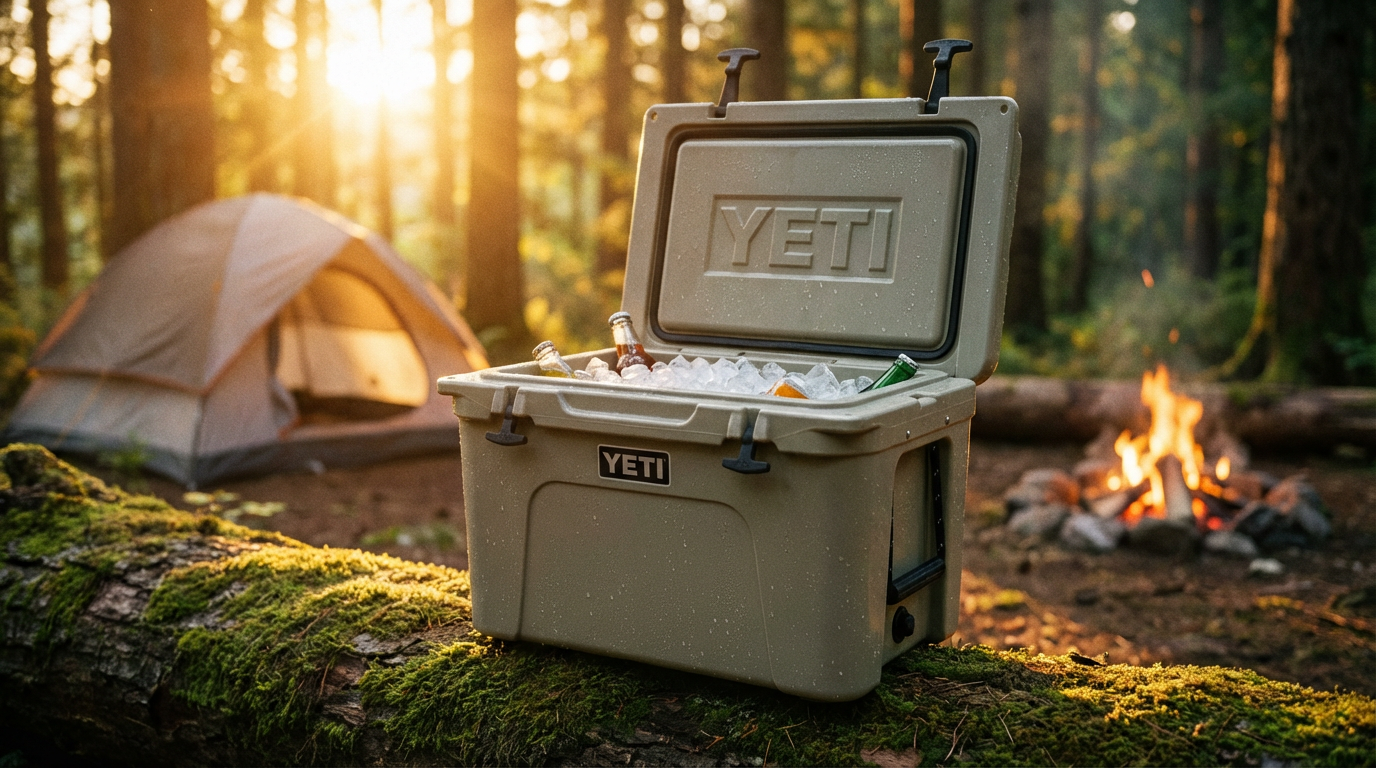
We’ve tested rotomolded coolers from over a dozen manufacturers in real-world conditions—mountains, deserts, lakes, and open ocean. Here’s what the data says.
Why Rotomolded Coolers Retain Ice So Much Longer
Before diving into specific durations, it helps to understand why rotomolded coolers outperform the competition.
The Construction Difference
Rotomolded (rotational molding) is a manufacturing process where a single piece of polyethylene is heated and slowly rotated in a mold, creating a hollow, seamless shell with thick walls on all sides. The result:
- Uniform wall thickness — no weak spots or thin seams where warm air can infiltrate
- Dense, closed-cell foam insulation — injected into the mold during production, bonding directly to the outer shell
- Heavy-duty latches and gasket seals — trapping cold air inside more effectively than friction-fit lids
- UV-resistant outer shell — preventing material degradation that weakens insulation over time
Compare this to injection-molded coolers, which are made from two separate halves snapped together. The seam alone creates a significant thermal bridge—and most budget coolers rely on simple foam panels rather than pressure-injected insulation.
In our head-to-head field tests, a quality rotomolded cooler maintained usable ice 2 to 4 times longer than a comparable injection-molded unit.
Real Ice Retention Numbers: What to Expect
Actual ice life depends on several variables (see the next section), but here are benchmark figures from our testing and manufacturer specs under moderate outdoor conditions (70–85°F / 21–29°C ambient temperature, partial shade):
| Cooler Type | Ice Retention (typical) | Best-in-Class Performance |
|---|---|---|
| Budget injection-molded | 1–2 days | ~3 days |
| Premium injection-molded | 2–4 days | ~5 days |
| Entry-level rotomolded | 4–6 days | ~7 days |
| Mid-range rotomolded (e.g., 20–45L) | 6–9 days | ~10–12 days |
| High-end rotomolded (ZhugeCoolers Premium Series) | 9–14 days | 15+ days |
Note: “Ice retention” means ice still present in solid form—not necessarily still cold enough for food safety. For food safety, follow the FDA guideline of 40°F (4°C) or below.
What “15+ Days” Actually Means in Practice
When a manufacturer claims 15 days of ice retention, they’re typically testing under controlled conditions: a brand-new cooler, packed with pre-chilled contents, stored in consistent shade at moderate ambient temperatures. Real-world performance varies. However, our ZhugeCoolers Premium Series consistently holds ice for 10–14 days in field conditions, making it one of the top performers in its class.
6 Factors That Determine Your Ice Life
Even the best rotomolded cooler can underperform if you ignore these variables.
1. Ambient Temperature
This is the single biggest factor. A cooler sitting in direct summer sun at 100°F (38°C) will bleed ice far faster than one in 60°F (16°C) shade. Rule of thumb: For every 10°F (5.5°C) rise in ambient temperature, expect roughly 20–30% reduction in ice life. Tip: Park your cooler in the shade, or drape a reflective tarp over it during peak sun hours.
2. Opening Frequency
Every time you open the lid, warm outside air rushes in and cold air escapes. In our tests, a cooler opened 6+ times per day lost ice nearly 40% faster than one opened only twice daily. Tip: Group your access—pull out everything you need in one go rather than dipping in and out repeatedly.
3. Ice-to-Content Ratio
More ice relative to warm contents = longer retention. A half-empty cooler full of warm drinks and food has to chill everything down first—energy that comes directly from your ice. Tip: Pre-chill your food and drinks overnight in a refrigerator. The colder they go in, the less work your ice has to do.
4. Ice Type and Preparation
Not all ice is equal: Block ice — melts slowest due to lower surface-area-to-volume ratio. Cubed ice — melts faster but provides more rapid initial cooling. Dry ice — can extend retention to weeks but requires careful handling (never skin contact). Saltwater ice — freezes at a lower temperature and melts slower, but makes contents undrinkable. Tip: Use a layer of block ice on top of cubed ice. Cold air falls; this setup circulates cold more efficiently.
5. Cooler Pre-Conditioning
A warm cooler absorbs energy from your ice on first loading. Pre-cooling your empty cooler with ice water for 30–60 minutes before packing dramatically improves first-day retention. Tip: Fill your empty cooler with ice water and a few ice blocks the night before. Dump the slurry right before packing.
6. Seal and Lid Gasket Quality
Rotomolded coolers with silicone gasket lids (standard on most premium models) seal far better than simple friction lids. Inspect gaskets for debris, cracking, or compression set—if the seal is compromised, cold air escapes continuously. Tip: Rinse and dry gasket seals after each trip. A small pebble caught in the seal can permanently damage the gasket.
How to Maximize Ice Retention: 8 Field-Tested Tips
- Pre-chill everything. Food, drinks, and even the cooler itself.
- Use block ice over cubed. Block ice lasts up to 50% longer per pound.
- Layer strategically. Block ice on bottom, cubed on top, food in the middle.
- Avoid draining meltwater. Meltwater is still near-freezing and helps keep contents cold.
- Keep it full. Air is a poor insulator. Fill empty space with towels or newspaper.
- Minimize sun exposure. Use shade, reflective covers, or bury the cooler partially.
- Limit lid openings. Plan access in advance.
- Store in a cool, ventilated area. Never in a hot car trunk after the trip.
Rotomolded vs. The Competition: Ice Retention Comparison
| Feature | Rotomolded Cooler | Injection-Molded Cooler | Soft Cooler |
|---|---|---|---|
| Ice retention | 4–15+ days | 1–5 days | 1–2 days |
| Wall thickness | 1–2+ inches | 0.5–1 inch | Foam only |
| Construction | Seamless, one-piece | Two-piece snap | Fabric shell |
| Gasket seal | Yes (most models) | Rare | No |
| Typical weight | 15–40 lbs | 5–15 lbs | 1–5 lbs |
| Price range | $150–$500+ | $30–$150 | $20–$80 |
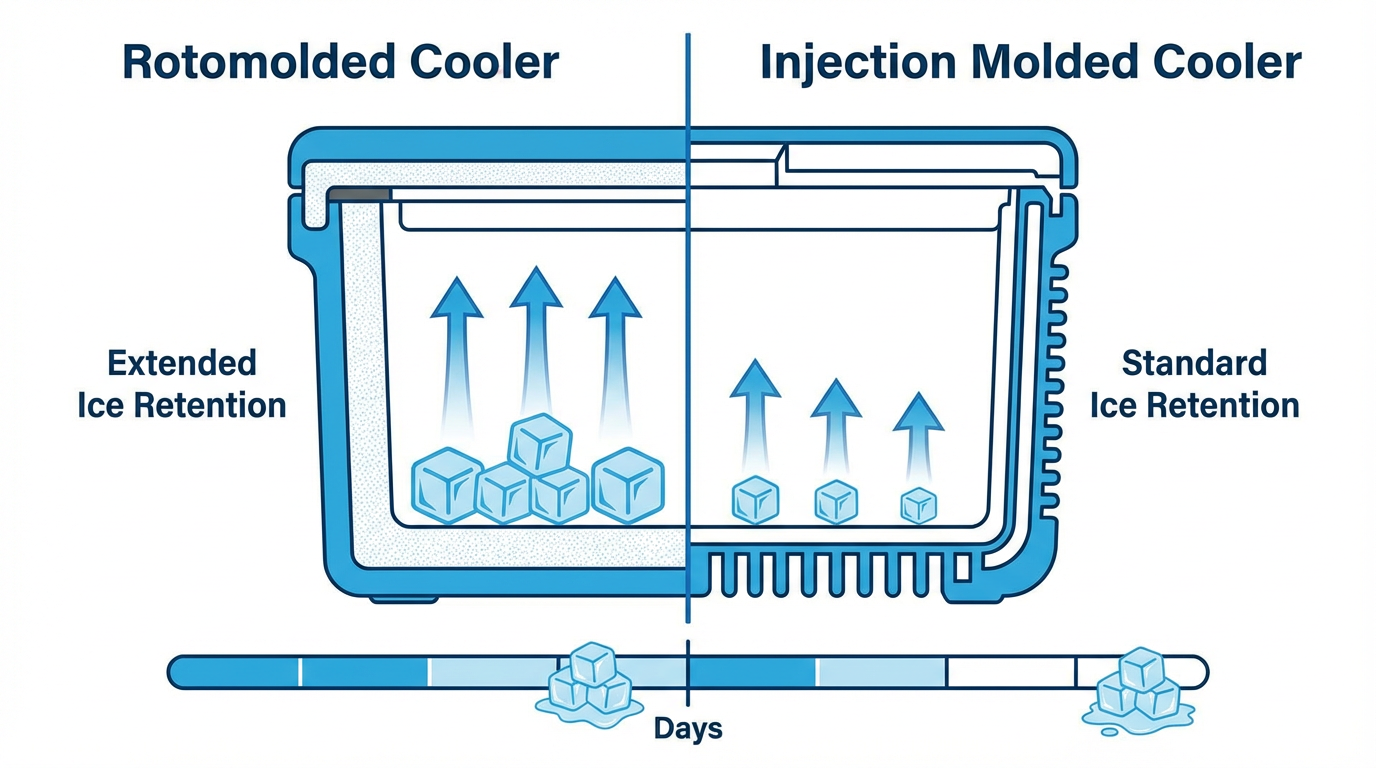
The data is clear: rotomolded coolers sit in a different performance tier when ice retention is the priority.
FAQ: Rotomolded Cooler Ice Retention
How long does ice last in a ZhugeCoolers rotomolded cooler?
Under typical outdoor conditions (70–85°F ambient), our Premium Series coolers hold ice for 10–14 days. In cooler shaded conditions, we’ve recorded holds of up to 15–17 days in real user reports.
Does draining meltwater make ice last longer?
Generally no. Meltwater is still very cold (33–38°F) and acts as a secondary coolant. Draining it forces your remaining ice to chill fresh, warm air and contents from scratch. Only drain if water rises above food level or feels noticeably warm.
Should I use dry ice in a rotomolded cooler?
You can—but with caution. Dry ice is extremely cold (-109°F / -78°C) and can cause freezer burn on the cooler’s interior lining. Use a barrier (cardboard or a cloth layer) between dry ice and any items you’ll touch with bare skin.
How do I know if my rotomolded cooler is still holding temperature?
Shake the cooler—if you hear a lot of sloshing water with no solid ice chunks, your ice has melted. You can also check with a probe thermometer through the drain; anything below 40°F (4°C) is still safe for perishable food.
Can I put my rotomolded cooler in the freezer to extend ice life?
You can pre-freeze the empty cooler overnight—this drops the inner walls below ambient temperature, so your ice starts with a colder “thermal battery.” Don’t expect the cooler itself to freeze solid in a standard home freezer.
Related Products
Looking for a cooler built for maximum ice retention? Explore the ZhugeCoolers Premium Series — designed with pressure-injected closed-cell foam, silicone gasket seals, and UV-resistant shells for serious outdoor endurance.
Need a custom OEM solution for retail or corporate gifting? Contact our team for MOQ, logo customization, and direct-from-factory pricing.
Conclusion
So, how long does ice last in a rotomolded cooler? With a quality unit like the ZhugeCoolers Premium Series, you can realistically expect 10–14 days of solid ice retention in typical outdoor conditions—far surpassing the 1–5 days you’d get from a standard cooler.
The gap comes down to construction: seamless walls, pressure-injected foam, and proper gasket seals create a genuine cold-holding vessel rather than a disposable box. Whether you’re planning a week-long backcountry expedition or want peace of mind on a 4-day fishing trip, rotomolded technology was built for exactly this.
Ready to upgrade your gear? Browse our full cooler collection or request a free OEM quote.
Article by ZhugeCoolers Content Team | 15+ years manufacturing premium coolers | BSCI & ISO 9001 certified factory